
FBM Musings: Shiny Objects & Sunk Costs
The Bid That Cost Me Four Weeks

(Please note some links below are affiliate links where I may earn a small commission at no extra cost to you.)
On May 19, 2026, the Atlanta Braves did something I should have done two weeks earlier.
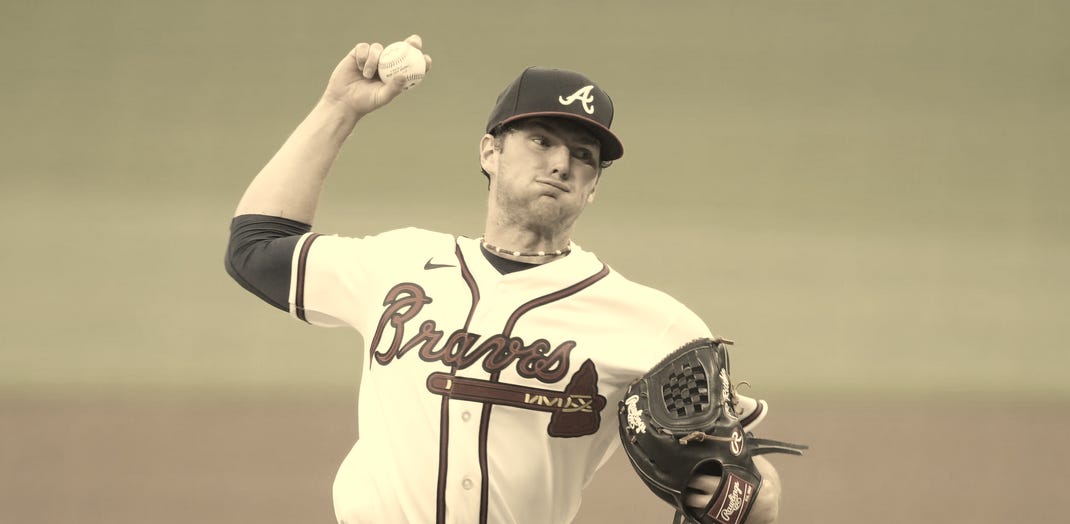
They had seen enough pitching from JR Ritchie.
In Week 6 of this 2026 NFBC season, fantasy managers across all leagues paid a combined $8,506 in FAAB to acquire this rookie pitcher. The average winning bid was $198.
I was one of those managers. My winning bid on JR Ritchie was $96. The total number of drops across the NFBC high stakes Main Event leagues between April 26 and his demotion to Triple-A on May 19: zero.
No secret that I am dropping him this Sunday.
But, why did I and other fantasy managers decide to bid and then hold him this whole time?
Shiny New Object Syndrome
Rookie pitchers break our brains.
When a top-100 prospect makes a dazzling MLB debut of seven innings, seven strikeouts, two earned runs against the Nationals on April 23, the cognitive picture gets overwhelmingly weighted toward the new, vivid, salient data point. The five years of professional development collapse into one box score. The underlying skills questions recede. The story takes over.
Daniel Kahneman called this mental shortcut the availability heuristic: when an example is vivid, recent, and easy to recall, the mind treats it as more representative than it actually is. Seven shutout innings of dazzling work against a great offense, broadcast on the MLB Network, written up by every analyst, replayed on every highlight reel, is the most available data point. Twenty-seven Triple-A innings of work with a 4.42 xFIP, 46.7% F-Strike%, and 12% BB% is not.
Add the rookie premium along with pitching for a great team with an available rotation spot at the time. A new player has no track record of MLB failure yet. All prior evidence is consistent with becoming a star. The variance is real but invisible. The upside is what everyone sees.
The result was $8,506 in NFBC community FAAB spent on a pitcher whose underlying skill profile as evaluated in one study in The Process (AAA xFIP as a leading minor-league-to-MLB indicator) was probably indicating a 4.50 ERA arm.
The Original Sin Was the Bid, Not the Hold
From the old Catholic school days, it’s confession time.
Yes, I did hold on to Ritchie too long. That’s true.
But the real mistake was the bid itself.
On April 26, before I placed the waterfall, I had reviewed Ritchie’s underlying minor league numbers. They were a mixed bag. His Gwinnett ERA was 0.99, but his xFIP was 4.42. His F-Strike% was 46.7%, well below the MLB average of about 60.8%. His swinging strike rate was MLB-average. Fine, not great. The Process is explicit that for minor league pitchers, surface ERA is a story; the underlying skills are the truth.
I also reviewed Connor Prielipp that same FAAB weekend. His xFIP was 3.07. His K-BB% was meaningfully better than Ritchie’s. The underlying skills said Prielipp was the better pitcher. I struggled mightily in going back and forth wanting to bid higher on Prielipp instead of Ritchie. Instead?
I bid $96 on the worse pitcher and $25 on the better one.
Why?
The Braves team context, very good minor league surface stats, recency bias of first MLB start, the pitching injury landscape and the “wisdom” of the crowd. The crowd had spoken by leaning hard into the dazzling debut and the top-prospect pedigree. Though to be fair, from the trusted sources I use, there were recommended bids, but certainly not in a “go get him”, max bids authorized way. I would call those recommendations cautiously optimistic with good ratios and volume.
That was one the main reason for me why I couldn’t quite place Prielipp over Ritchie. The pitching volume history. Prielipp had only pitched 5 innings or more three times total in 2025 and 2026. I did have real concerns about whether he would pitch to qualify for a win, but I believed that the underlying skills were much better than Ritchie. So I deferred to the market and overrode my own framework.
But I’m not one of those blame the fantasy analysts type managers. I take responsibility for my own actions and my own money. As a grown adult, I have the disposable income to play fantasy baseball at the level I play it.
To quote one of my favorite throwaway lines from The Bear:
“Do I have $500 dollars? Yes, I’m a 43 year old man, of course I have access to $500.”
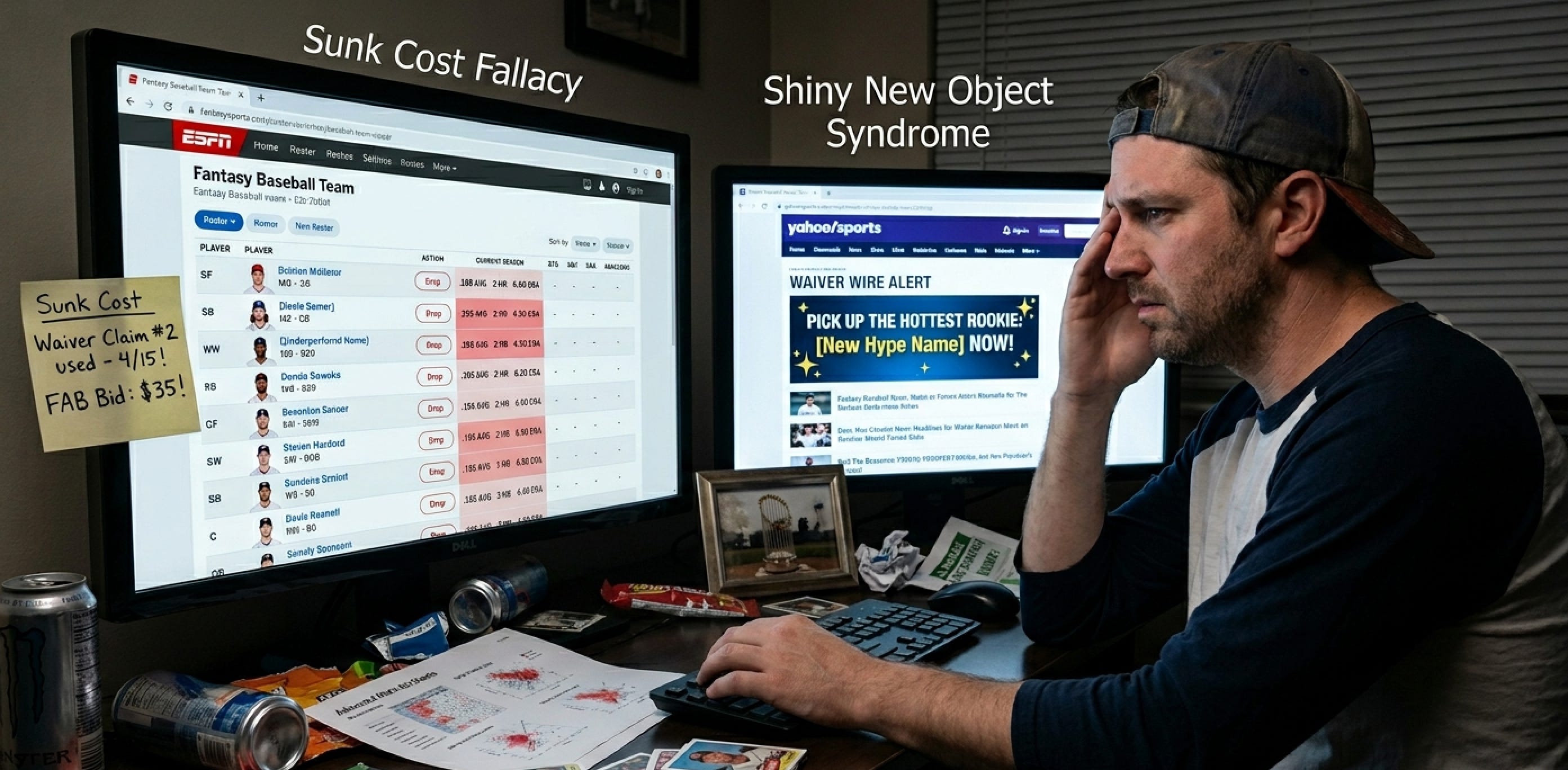
Do I have $96 of FAAB? Yes, it was late April. Of course I still have access to $96. I put that FAAB amount down. The mistake was mine. So, shiny new object syndrome is what got me into the position. Sunk cost is what kept me from getting out.
The Mechanism Behind the Hold
In a recent Choiceology episode on sunk cost, Richard Thaler, Nobel Laureate and professor, explains why investors hold losing positions too long. After studying a decade of trades by professional portfolio managers, the following observation was made. These managers had measurable skills in choosing what stocks to buy, but negative skills in choosing what to sell. Selling random stocks from their portfolio would have outperformed their actual sell decisions.
Thaler’s diagnosis is one of the clearest ways to understand sunk costs:
“If I have a stock that’s gone down, I don’t have to admit that I made a mistake. Until I sell it.”
That is the mechanism. Every Sunday between April 26 and now, I had the chance to drop Ritchie. Every Sunday, I didn’t. Because every Sunday I didn’t drop him, the $96 was still a bet that might come back. The moment I drop him, the bid becomes a confirmed mistake.
Adam Young of FTN put it in fantasy terms in one of his prior strategy articles on human psychology: “It’s always difficult to part ways with players we believed in…We can’t afford that type of loyalty as fantasy managers.”
The loyalty isn’t to Ritchie. The loyalty is to the version of me who made the bid.
What It Cost Me, Concretely
Sunk cost in fantasy is not just the FAAB dollars. It’s the bench spot. The slot I couldn’t allocate to anyone else while I was waiting for the bet to pay off.
In Ritchie’s four starts on my roster, the fantasy stats accumulated were:
⚾️ 13.2 IP, 0 W, 12 K, 5.27 ERA, 1.46 WHIP
Meanwhile, the following Sunday on May 3, I picked up Cade Cavalli and Luis Severino. Both are still on my roster. Both contributing. As of this week:
⚾️ Cavalli: 2 W, 33 K, 3.72 ERA, 1.24 WHIP
⚾️ Severino: 1 W, 32 K, 3.26 ERA, 1.32 WHIP
Both pitchers were available on April 26 because no one in my league had bid on them. The crowd was on Ritchie. I was on Ritchie. The actually useful pitchers were sitting in plain sight, and I had to outbid for them a week later because the market had finally noticed.
I’m currently sitting in 8th place. That gap is not the gap of “one bad FAAB bid.” It is the gap of one framework override, plus four weeks of holding, plus the alternative universe in which my $25 bid for Prielipp was my first choice. That would have yielded:
⚾️ 1 W, 23 K, 2.57 ERA, 0.95 WHIP.
The Sunday Question
When the host of Choiceology asked Thaler what practical advice he gives to anyone who hasn’t spent decades studying sunk cost, his answer was simple. Before any decision to keep or continue something you’ve already paid for, ask yourself:
“Would I do this if it had been free?”
You can ask that same question every Sunday, weighing the players on your roster against the players in the available pool.
But asking the question is one thing. Hearing yourself answer honestly is another. Sunk cost is sticky. The bid you placed last month becomes a story your brain works hard to protect. So how do you put guardrails around your future self?
A few things I’m experimenting with. None of them solve it. Each makes the honest answer slightly easier to hear.
Hide the FAAB bid column. After the add, stop displaying what you paid. The number anchors you. If you can’t see it, you can’t defend it.
Run Thaler's inversion every Sunday. For every borderline player on the roster: if he were on waivers tomorrow with no FAAB cost and no history with me, would I bid anything to add him? If not, the bench spot is already mis-allocated.
Pre-commit your criteria at the time of the bid. Before placing the $96 on Ritchie, I should have written down: “If after four starts his K-BB% is below 10% and his ERA is above 5, I drop. Full stop.” Past-me sets the bar. Future-me just reads it. Pre-commitment is how you outsource your discipline.
None of these are magic. And there’s a complication I’ve been wrestling with.
Ron Shandler has spent four decades telling fantasy managers to exercise excruciating patience. Don’t overreact to two weeks of bad results. Don’t drop a good-skill player on a slump. The history of fantasy baseball is paved with managers who dropped someone too early and watched them get hot for a new team in August.
That advice is true. And it does sit in direct contradiction with everything I just wrote about combating sunk cost.
How do you reconcile? The honest answer, and Shandler’s writing has me reconsidering this, is that the two principles apply to different cases.
Patience is right when underlying skills are strong but surface results are bad. Good xFIP, lousy ERA. Good barrel rate, no luck. Ride through it.
Sunk cost diagnosis is right when the surface results are bad and the underlying skills were never there or have clearly deteriorated. No amount of patience will fix a skills problem.
The Ritchie story isn’t a patience story. The current underlying skills told the truth from the beginning.
One Reflection to Close
The Braves made rational decisions on both ends of the Ritchie story. They called him up on April 23 because Spencer Strider was on the IL with an oblique strain and they needed rotation depth fast. They demoted him on May 19 because Strider was back, the staff was healthier, a six-man rotation no longer made sense, and Ritchie’s performance was underwhelming to bad. Both decisions were responses to baseball circumstances.
Mine weren’t. My bid was a response to a debut and a market price. My hold was a response to the bid I’d already made.
The Braves were doing baseball. I was doing sunk cost.
The Process gives us a framework to evaluate underlying skills instead of surface ERA. Adam Young reminds us that loyalty to players we believed in costs us standings points. Thaler tells us to ask the simple forward-looking question every time. Kahneman names the cognitive bias that lights up when a rookie tosses seven shutout innings.
I had all of it. I overrode all of it.
The discipline isn’t having the framework. It’s using the framework when the shiny new object is right in front of you. Otherwise the framework is just decoration — a thing we tell ourselves about ourselves, instead of a thing we actually do.
Your roster spot, like your FAAB budget, is not yours to keep. It is yours to allocate, every week, to the best forward-looking answer. Past bids and past holds have no claim on present allocation.
The shiny object will come again next week. So will the temptation.
The past, like the bid, is sunk.
Thanks for reading.
Take care.