
FBM Musings: Inside the Harada Method Grid
The 8 Success Markers for Fantasy Baseball


(Please note some links below are affiliate links where I may earn a small commission at no extra cost to you.)
Last week I introduced the Fantasy Baseball Harada Method Grid.
8 success marker blocks, 64 actionable tasks, one goal at the center.
If you missed it, start there.
This week, we’re going to dive into each one of the 8 success marker blocks.
You can split the grid into two phases: what you do before the season and what you do during it.
Foundation Before the Draft
Here are the four blocks that help you before Opening Day. Remember, you can’t win your league on draft day, but you can lose it. These pre-season grid success makers reward preparation.
In-Draft Strategy & Tactics
The draft is the highest-leverage event of your fantasy season. Every decision compounds. The research from “The Process” is clear: managers who spend an early pick on a severe under-performer rarely win their league and seldom finish in the top three.
But the block isn’t about picking the right player. It’s about having a system that produces good decisions under pressure. Build a draft plan with flexible tiers, not rigid rankings. Being extraordinarily stubborn with rankings creates brittleness. And, brittle things break easily.
When you use a rigid ranking system, it creates the illusion that the gap between draft pick #1 and #2 is the same as #7 and #8. Study your league’s ADP tendencies, but remember that ADP is an intelligence report on your competitors, not a ranking system. It’s slow to respond to real changes in value.
The most underrated task in this block: build a “break glass” contingency list. Every draft plan meets a moment where the board doesn’t cooperate. As Morgan Housel states, “risk is what you don’t see.”
Pre-decide what you’ll do when that happens. Decisions made during calm preparation are better than decisions made in the heat of a positional run.
Sense of Value
There are two types of value in fantasy baseball: intrinsic value and market value. Intrinsic value is what a player is actually worth based on projected production over replacement level. Market value is what other people are willing to pay. The gap between the two is where your edge lives.
The experts I surveyed understand this distinction instinctively (link to the survey results). They compare their own valuations to industry ADP and hunt for discrepancies. They know that a $30 player is only a $30 player if someone in your draft pays $30 for him.
The most important task in this block is distinguishing price from value. A player going in the third round of ADP who your research says is a fifth-round talent isn’t a bargain just because he’s popular. A player’s ADP dropping doesn’t create value. Your evaluation does.
If you were already out, a falling price changes nothing. You’re just watching the market agree with you. If you were already in, a falling price changes everything. You’re getting the same skill set for less draft capital.
The market just sets the price. It doesn’t decide what’s valuable. You do.
Player Projections
This block can be controversial in the fantasy baseball community. Some managers swear by it. Some claim to barely look at it when forming their draft day targets.
In either case, I believe fantasy champions understand what most managers don’t: projection accuracy has a ceiling, and that ceiling is lower than we want to believe.
Even if you project a player’s batting average dead-on, you’ve just been lucky with your dart throws. The best projections aren’t the most accurate ones; they’re the ones that are just far enough from the field of expectation to alter your decision-making. Projecting a consistent .250 hitter to improve to .290 is more valuable than correctly projecting a .300 hitter to hit .300 — because the first projection changes your draft behavior and the second one doesn’t.
The actionable takeaway: use multiple projection systems, weight skills metrics over surface stats, and embrace imprecision. Ranges are more honest than point estimates. Tracking where you differ from consensus is where your edge is.
Use & Access to Time
Research supports the idea that better decisions are made when more time is spent analyzing the important input variables.
But this block isn’t about spending more time. It’s about spending time better. Block a weekly session for roster review instead of checking your lineup six times a day. Batch your FAAB research into one focused session instead of spread across a distracted week. Invest in learning systems and frameworks rather than consuming an endless stream of player takes.
The most counterintuitive task in this block: automate data tracking where possible. Every hour you spend manually updating a spreadsheet is an hour you’re not spending on the decisions that actually move the needle. Free your time for high-leverage thinking.
The four blocks above are the off-season work.
Now, what happens when the games start?
In-Season Execution
Once the season starts, this is where most managers lose the ground they gained in the draft. The pre-season grid rewards preparation. The in-season grid rewards discipline. And the early rabbits tire out quickly. Remember, the tortoise always wins.
In-Season Roster Management
This was the #1 ranked variable in my survey. Thirty-eight percent of the 34 elite managers I asked put it first. It makes sense. A great draft with poor in-season management is a car with a full tank of gas and no driver. It looks great in the garage.
The most important task in this block is having your FAAB bidding criteria defined in advance. Categorize each week’s free agents into three buckets:
triage (warm body)
tactical (short-term fill)
strategic (difference-maker)
In many weekly leagues, set your initial bids before the weekend so Sunday decisions are executions of a process, not expressions of whatever hype dominated your timeline that morning. Understandably, there can be critical player news happening on Sundays prior to FAAB deadlines. Being prepared ahead provides you flexibility to adjust quickly.
Also, for anyone in trading leagues, the 48-hour rule belongs here too. Don’t make a major trade in the two days after a bad week. Bad weeks are noise, not information. Your slow brain deserves a chance to overrule your fast brain.
Contextual Elements That Affect Players
This block is about the information layer that sits between your projections and reality. Ballpark effects, managerial tendencies, lineup construction, trade deadline implications, minor league call-up timelines — none of these show up in a stat line, but all of them affect the stat line.
Any reported actions, especially bullpen closer announcements, can easily be reversed based on subsequent events. The real intelligence is in the patterns, not the headlines. Track which MLB managers give long leashes to struggling closers and which ones make quick hooks. Know which MLB teams are buyers and which are sellers before the deadline, not after.
The most actionable task here: note schedule strength for streaming. A mediocre pitcher facing a weak lineup is often a better play than a good pitcher facing a strong one. When the difference in opposing offense is severe, playing match-ups pays off.
Manufacturing Luck
You can’t control which players break out. But you can control how many chances you give yourself to be on the right side of variance.
Maximize plate appearances and innings pitched. Roster players on good offenses where run production lifts individual counting stats. Be early on breakouts rather than late. Research in “The Process” found that the biggest driving force behind a season’s most profitable players was changes in playing time, and more than 70% of those changes were unpredictable on draft day.
The principle is surface area. The more roster spots you have in play, the more chances you have for something good to happen. Own more tickets to the lottery. Twenty-five percent of fantasy teams with one or more of the season’s most profitable players won their league outright. You can’t predict who those players will be. But you can make sure you’re in position to find them.
Emotional Discipline & Process
I added this block because the original seven markers describe what winning managers do. This one describes how they think while doing it.
Every other block on the grid is undermined without this one. In-season roster management falls apart when you panic-trade after a bad week. Your sense of value evaporates when recency bias convinces you to chase a hot streak. Your time management collapses when anxiety has you refreshing your lineup page instead of doing focused analysis.
Stoic philosophy draws a hard line between what is within your control and what is not. Your decisions, your preparation, your response — those are yours. Injuries, opponent luck, the random variance baked into a 162-game season — those are not. The practice is simple: invest your energy entirely in the first category.
Practically, this looks like keeping a decision journal. Write down why you made the move, what information you used, what you expected. At the end of the season, audit the decisions, not the outcomes. A good decision that produces a bad result is still a good decision. A bad decision that gets lucky is still a bad decision. Over time, the manager who makes better decisions will beat the manager who gets luckier.
The Full Grid
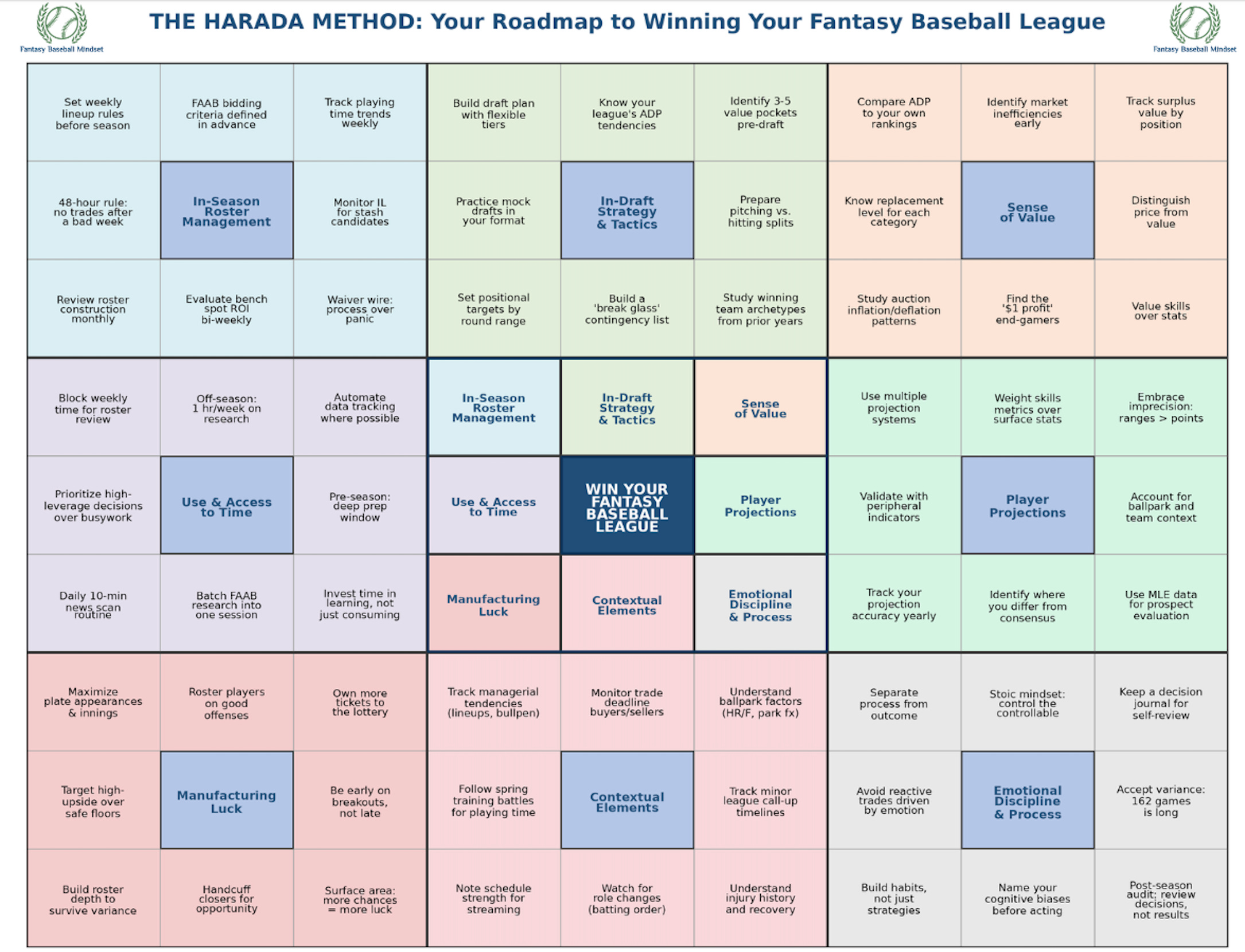
As mentioned last week, you don’t need all 64 tasks working at once. Pick the one block where you’re weakest and build your own 8 tasks around it.
The grid is a compass, not a checklist.
Use it to know where to point your effort next.
Thanks for reading.
Take care.
This one is good